

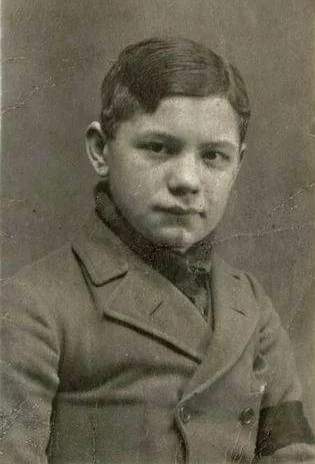
From Birth to the Start of His Career
Attila József was born on 11 April 1905 in Budapest, in the Ferencváros district, in the house at 3 Gát Street. His father, Áron József, was a soap-maker by trade, and his mother, née Borbála Pőcze, was a homemaker.
The head of the family abandoned his family on 1 July 1908. The mother took work as a day labourer, going to well-to-do households to wash, iron and clean, so as to provide her children with the barest necessities.
1910–1912. The National Child Protection League placed her two younger children, Etelka and Attila, with foster parents in Öcsöd.
In 1912–1913 the boy, then an elementary-school pupil, tried his hand at both lawful and unlawful ways of earning a living. He stole firewood, carried baskets from the market hall, sold colourful paper windmills and sold water in cinemas.
At the end of 1914 the first signs of Mama's uterine cancer appeared.
As wartime poverty deepened and Mama's illness grew worse, the young boy had to take on an ever larger share of providing for the family: queuing outside shops for food and taking odd jobs. During this time he also worked as a newspaper boy.
The poet's first juvenile attempts at verse date from this period, including his earliest surviving poem, “Dear Jocó!” (Kedves Jocó!).
Jolán József became an employee of the lawyer Ödön Makai; a friendship, and eventually a romantic relationship, developed between them. With the lawyer's help, in November 1917 the two younger József siblings were placed in a children's home in Monor, and in the summer of 1918 they spent a holiday in Abbazia (Opatija) as part of King Charles's children's holiday programme.
Ödön Makai and Jolán József married in 1919. Because of this marriage, Makai's family boycotted him.
In the autumn of 1919 Mama was admitted to the emergency hospital on Telep Street. She died there during the night of 27 to 28 December 1919, while her son was staying with relatives in Szabadszállás.
He was first sent to Nyergesújfalu to the Salesian order as a seminarian; then, in the summer of 1920, he became a ship's boy on the dredgers of the Atlantica Maritime Shipping Company Ltd.
In 1920 Ödön Makai enrolled him in the grammar school in Makó and obtained a place for him in the Makó boarding house of the Southern Hungarian Society for Public Education (DEMKE).
From 1921 onwards he wrote poetry continuously.
In the spring of 1922 the leading figures of Makó's intelligentsia took notice of the talented student. The home of János Espersit, a left-leaning lawyer, lover of art and literature and patron of the arts, was a meeting place for writers and artists from Makó and even from Szeged. It was here, in February or April 1922, that Attila József was introduced to Gyula Juhász. For the summer holidays he hired himself out as a cornfield watchman in Kiszombor. On 1 November 1922 the Szeged journal Színház és Társaság published his poems “Far Away, at the Piano” (Távol, zongora mellett) and “My Forefather” (Ősapám), introducing their author in a few sentences. This publication marked the beginning of Attila József's career as a poet.
Gyula Juhász wrote the preface to his volume “The Beggar of Beauty” (A Szépség koldusa). On 17 December he brought the copies of his first volume back from Szeged.
1923On 10 January he left the grammar school. In response, Ödön Makai withdrew his financial support in order to bring his ward back onto “the right path”. The poet decided to take a combined examination covering the material of the 7th and 8th years of grammar school. The 16 April 1923 issue of Nyugat published his poems “Name-Day Praise” (Névnapi dicséret), “Call to the Road” (Útrahívás) and “Sacrilegium”. In May the twenty-fifth anniversary of Gyula Juhász's poetic career was celebrated. On this occasion the poet met Mihály Babits, Dezső Kosztolányi and Lőrinc Szabó. On 25 June he passed the examination in the 7th-year subjects with the grade “good” and in the 8th-year subjects with the grade “satisfactory”. On 13 December he took his school-leaving examination at the Werbőczy Grammar School in Budapest. In Hungarian, Jenő Pintér, chief director of the school district, graded his performance as “satisfactory”.
1924He worked as a book agent for the Fővárosi Könyvkiadó (Metropolitan Publishing House), and then as a bank clerk at the Mauthner private bank. On 10 July, because of his poem “Rebel Christ” (Lázadó Krisztus), the court panel presided over by Judge Schadl sentenced him to eight months' imprisonment and a fine of 200,000 crowns. In the autumn of 1924 he became a student of Hungarian, French and philosophy at the Royal Hungarian Franz Joseph University of Szeged. In Szeged he suffered great privation. His acquaintances often provided him with food: he “ate by days” (i.e. took his meals at different families' tables on set days). After Christmas his volume of poems “It Is Not I Who Cry Out” (Nem én kiáltok) was published.
1925On 25 March the poet's poem “With a Pure Heart” (Tiszta szívvel) appeared in the newspaper Szeged. On 30 March Professor Antal Horger, dean of the university, advised him to abandon a teaching career. In the first days of October he travelled to Vienna. In November he moved into the Collegium Hungaricum, whose director, Antal Lábán, took him under his patronage. He met Lajos Kassák, Andor Németh and Tibor Déry.
1926At the beginning of the year he was Endre Gáspár's guest for a few days, and then found lodging in a wretched student hostel. At the end of July he returned home to Hungary together with Andor Németh. Around 10 September he travelled to Paris. He kept in regular contact with the painter Margit Gráber, Kálmán Sándor and Imre Cserépfalvi. On 12 November he was enrolled as a student of the Sorbonne.
1927At the beginning of the year he made an in-depth study of the poetry of François Villon. The April issue of the journal Esprit Nouveau published one of the poet's poems written in French. – In mid-August he returned home to Hungary. On 28 September he enrolled at the Faculty of Arts of the University of Budapest.
1928In the first months of the year he met Márta Vágó, and a great love developed between them. Through Márta's father he came into closer contact with Gyula Illyés, Pál and György Kecskeméti, Pál Ignotus, Aladár Komlós and András Komor.
As his application to the Student Hardship Relief Programme, dated 21 April, attests, he lived in great poverty, rented a room as a subtenant in the building at 6 Andrássy Avenue, and was preparing for his basic university examination.
1929His volume of poems “I Have No Father, No Mother” (Nincsen apám, se anyám) was published on 7 February 1929. On 18 February, at the “Hungarian Soil” evening of the Miklós Bartha Society, Attila József appeared in public for the first time as a member of the Society. In December he briefly became a contributor to the paper Előörs, edited by Endre Bajcsy-Zsilinszky. The 1 December issue of Nyugat carried a hurtful review by László Németh of “I Have No Father, No Mother”. This was one of the reasons for his sharp and unjust attack on Mihály Babits, which had serious consequences for him.
1930The anti-Babits pamphlet appeared under the title “The Gods Die, Man Lives” (Az Istenek halnak, az Ember él) in the 10 January issue of Toll. He joined his life with that of Judit Szántó.
1931In February, at the Jaurès Working Group, he read out a summary of his views on the philosophy of art, the free lecture “Literature and Socialism” (Irodalom és szocializmus). He had his volume of poems “Knock Down Capital, Don't Lament” (Döntsd a tőkét, ne siránkozz) printed after 18 March.
1932In June the first and only issue of the journal Valóság, edited by Attila József and Ferenc Fejtő, appeared. On 27 July Attila József, Gyula Illyés and Lajos Szimonidesz drafted the pamphlet “Against the Death Penalty”, all copies of which that could be found were immediately confiscated by the police. On 27 September, at the appeal hearing before the Curia (Supreme Court), he was found guilty over the volume “Knock Down Capital, Don't Lament”, but the sentence was suspended for three years. On 16 October the booklet of poems “Night in the Outskirts” (Külvárosi éj) was published.
1933On 28 January, citing his social circumstances, Attila József applied to Mihály Babits for a Baumgarten grant, which he later received. In February a hurtful review by Ferenc Pákozdy of “Night in the Outskirts” appeared in Társadalmi Szemle. In April, after a break of several years, Nyugat once again published a poem by Attila József. In mid-June, at the IGE writers' week in Lillafüred, the poet met Márta Marton, who inspired him to write “Ode” (Óda).
1934At the beginning of the year Attila József's life together with Judit Szántó fell into a serious crisis. In mid-February the poet moved to Hódmezővásárhely to stay with Ödön Makai and Eta József, where he remained until the end of June. There he prepared the editing of the volume “Bear Dance” (Medvetánc). In the autumn of 1934 the Révai Literary Institute Co. undertook the publication of his volume of selected poems, with the help of Lajos Hatvany, Henrik Herz and Bertalan Hatvany. The volume appeared at the beginning of December under the title “Bear Dance”.
1935On 15 January the board of trustees of the Baumgarten Foundation rewarded Attila József's literary work with the so-called “small prize” of one thousand pengős. On 22 March Gyula Illyés and Lajos Szimonidesz were acquitted in the trial over the pamphlet “Against the Death Penalty”, while the court ordered Attila József to pay a fine of 200 pengős. From the spring of that year the poet underwent psychoanalytic treatment with Edit Gyömrői. In the autumn of the same year Attila József and Márta Vágó became close again. On 27 December Attila József and Pál Ignotus signed a contract with Imre Cserépfalvi to launch the journal Szép Szó.
1936At the end of February the first issue of Szép Szó, dated March, appeared, followed in May by its special Book Week issue, “Today's Hungarians on Hungarians of Old” (Mai magyarok régi magyarokról), which opened with Attila József's poem “By the Danube” (A Dunánál). In the summer of 1936 Attila József parted from Judit Szántó for good. Before Christmas his last volume of poems, “It Hurts So Much” (Nagyon fáj), was published by Cserépfalvi. The poet was deeply disheartened by the fact that this time, too, his poems met with no success among the public.
The Last Year
1937At the reading evening held on 13 January in honour of Thomas Mann at the Magyar Színház (Hungarian Theatre), the Ministry of the Interior banned the performance of the festive ode that Attila József had written for the occasion. At the end of February he met Flóra Kozmutza, the inspiration for the last series of his love poems. In May the special Book Week issue of Szép Szó appeared under the title “What Is Hungarian Now?” (Mi a magyar most?), opening with Attila József's sonnet cycle “My Homeland” (Hazám). In the second half of July the poet suffered his last, tragic nervous breakdown. On 4 November the poet left the Siesta Sanatorium and travelled to Balatonszárszó. His friends in Budapest planned to secure him a position as a publisher's reader at the Pantheon publishing house if his condition improved. The board of trustees of the Baumgarten Foundation unofficially informed the poet's relatives that they intended to award him the Baumgarten Prize that year. His sisters, however, did not want to unsettle the poet with news that was still uncertain.
On 3 December 1937, at 7:35 p.m., Attila József took his own life at Balatonszárszó railway station. He crawled between wagons no. 1963 and no. 1964 of freight train no. 1284 as it slowly began to move, and was run over and killed by the train.
He was buried on 5 December 1937 in the Balatonszárszó cemetery.